
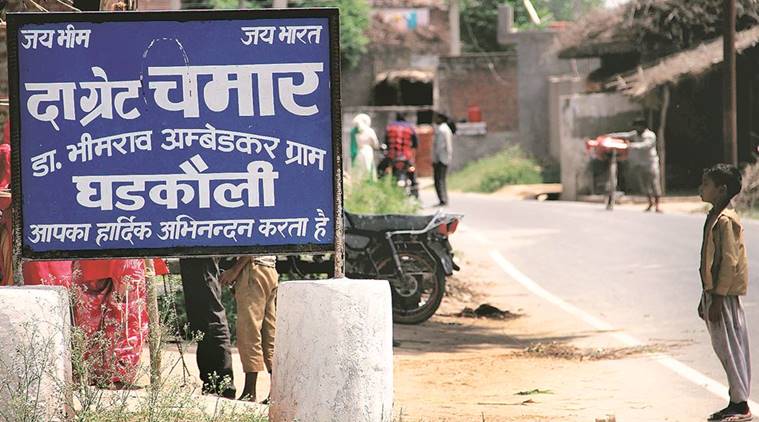

As incidents of violence against Dalits mount in Gujarat, it is worth recalling the India of Ambedkar’s dreams
The steps, if any, initiated by the government through a special session of the Lok Sabha on atrocities after the Una incident last year, have not had an impact on the violence against Dalits in Gujarat. On the contrary, there has been an increase of incidents which the Supreme Court had earlier described as “offences being shockingly cruel and inhumane”. From 1995 to 2015 about 9,926 incidents have been registered — about 473 per year — under the Protection of Civil Rights Act (1955) and the Prevention of Atrocities Act (1989). The annual number of cases has jumped from 212 in 2013 to 1,010 in 2015. This trend indicates a growing caste divide in rural Gujarat.
The question is: Why are Dalits denied equal rights despite laws against such a denial? Why is violence, not democratic methods, used to resolve caste issues? Although B.R. Ambedkar was instrumental in developing legal and other measures to ensure equality, he was not very optimistic about the effectiveness of some of these measures and he offered alternatives. Now that political parties have seemingly begun to respect Ambedkar’s vision, it will be useful to recall his views on the limitations of the present policies and the solution he offered for troubled times such as these.
It was Ambedkar who brought the ban on untouchability under the purview of the fundamental rights in the Constitution and later helped to enact the Untouchability (Offences) Act (1955). But he was more aware of its limitations than anybody else. In his view, laws could be effective if violated by an individual but not when the entire community is opposed to the rights of a minority. He quoted Edmund Burke: “There is no method found for punishing the multitude. Law can punish a single solitary recalcitrant criminal. It can never operate against a whole body of people who are determined to defy it. Social conscience is the only safeguard of rights. If social conscience is such that it recognises the rights which the law chooses to enact, the rights will be safe and secure.”
Unfortunately, in Ambedkar’s view, the social and moral conscience that governs the caste system does not support equality. The social beliefs that support inequality continue to influence the behaviour of “high” caste people in the villages. This belief system is at the root of the denial of rights and the use of violent methods against Dalits. The past does not remain in the past; its legacy continues to influence behaviour towards Dalits. Matters are made worse by the motive behind the denial of equal rights — the preservation of economic and social status.
Ambedkar argued that the actions of people are a natural outcome of their belief in caste codes. Unfortunately, there is no engagement by the government and high-caste Hindu civil society with people who practise untouchability. On the contrary, the pendulum is swinging in the opposite direction. As studies show, till recently, atrocities were often motivated by caste consciousnesses, but the current wave seems to be driven by an ideology which expresses faith in a hierarchical social system, although there is an occasional symbolic display of concern about the persistence of caste and untouchability. It is this ideological boost which has, perhaps, revived and lent moral support to the denial of rights and the use of violence against Dalits. What is required are direct efforts towards building a social consciousness in support of equal rights for Dalits. Nothing else will work if a majority of the higher castes in villages are determined to oppose equality.
Along with legal and social hurdles, Ambedkar was equally aware of the economic and demographic imbalance between Dalits and high castes in villages. In 1942, he observed: “It is a contest between the Hindus who are economically and numerically strong and the untouchables who are economically poor and numerically small… the chief weapon in the armoury of the Hindus is economic power which they possess over the poor untouchables living in the village.” To correct this imbalance, Ambedkar suggested a geographical and economic distance between high castes and Dalits in the villages and argued for separate settlements or villages for Dalits, with independent sources of livelihood. Ambedkar was aware that the proposal may be “dubbed as an escapism”. But he defended it on the ground that the “consequence is perpetual slavery”. The uninterrupted cases of atrocities since 1955 would seem to bear out his apprehensions.
Ambedkar also argued that without securing equal rights for about one-fifth of the population — Dalits — we cannot become a true nation. In 1946, he warned: “The Nation is not a physical thing in which certain objective characteristics, such as commonality of language, race, territory, etc persist. Nation, on the contrary, is a spiritual reality binding people into a deep comradeship… It is a feeling of possessing things in common in life, of communication, participation and of sharing with all those who constitute one nation. Nation is a mode of associated living, of conjoined communicated experience.” Thus communication, participation and sharing with all those who constitute one nation is the key to nationhood. Twenty-one year old Jayesh Solanki was watching a garba dance celebration in a public space in Gujarat for which he was killed. Ambedkar’s idea of a socially inclusive nation is in the making but there is a hard and long way ahead of us to make it a reality.
